Jessica Pegula and the Sabalenka Equation: When the Line Between Elite and Champion Is Thin as a Forehand
core_answer: Jessica Pegula thua Aryna Sabalenka 5-7, 2-6 ở bán kết US Open 2024, dù có 50 trận thắng dẫn đầu WTA Tour mùa này. Pegula xếp hạng 3 thế giới, thiếu vắng 'cú giao bóng cứu hòa' khiến cô thua trận trước Sabalenka lần thứ ba liên tiếp tại New York.
key_facts: Pegula thua Sabalenka 5-7, 2-6 tại bán kết US Open 2024 — set hai bị bẻ break ngay ván đầu; 50 trận thắng mùa 2024 — dẫn đầu toàn WTA Tour, xếp hạng 3 thế giới; Pegula vào chung kết Washington, Cincinnati rồi bán kết New York — chưa có danh hiệu đơn nào mùa này; Lịch thi đấu tiếp: Singapore Open (WTA 500) từ ngày 21/9, chuyển đổi mặt sân cứng liên tục
source: Phân tích chuyên sâu VuaBong dựa trên dữ liệu WTA Tour 2024 | Cross-checked: VuaBong.vn
related_qa: Pegula có bao giờ vô địch Grand Slam không? — Tính đến US Open 2024, Pegula chưa có danh hiệu Grand Slam đơn nào, dù nhiều lần vào bán kết/bán kết sâu; Tại sao Pegula liên tục thua Sabalenka? — Phong cách return-first của Pegula gặp bất lợi trước lối đánh power-first của Sabalenka, thiếu cú giao bóng cứu hòa trong các trao đổi cao tốc; Pegula có rút khỏi Singapore Open không? — Chưa có thông báo rút lui tính đến thời điểm hiện tại; giải đấu bắt đầu 21/9 sau ba tuần thi đấu liên tiếp
Jessica Pegula and the Sabalenka Equation: When the Line Between Elite and Champion Is Thin as a Forehand
There is a moment in the press room after the US Open semifinal that few people noticed. Jessica Pegula, the world No. 3, held a Lavazza cup in her right hand and a beer in her left, then laughed that she was trying to hold her fluids to provide a sample in case she was called for random doping control. The room erupted in laughter. That was the response of someone who had grown accustomed to losing semifinals at this venue, accustomed enough to transform pain into a comic line that could be sold to a sponsor.
But looking more closely, Pegula's story at this year's US Open — a 7-5, 6-2 loss to Aryna Sabalenka — is not merely one match. It is the most concise summary of her current position in the women's tennis hierarchy: good enough that no one questions her belonging to the top tier, yet one step short of truly ruling that tier.
Context: Three hard weeks feel like three years
To understand this match, we need to rewind to the preceding sequence of results. Pegula arrived in New York after three consecutive weeks of hard-court tennis in North America: the Washington Open final, the Cincinnati Masters final, then the US Open semifinal. Three tournaments, three deep runs, zero titles. This is a familiar pattern — the "peaked then retreated" type that some call "gatekeeper-elite" players often fall into.
These results also placed Pegula in a difficult position: all three events were on hard courts, the surface she calls home, the surface where she feels most comfortable. An elite player cannot use surface familiarity as an excuse when that surface is supposed to be her territory.
Sabalenka arrived in New York as the defending champion. She didn't need to defend the crown; she needed to prove that the crown was deserved convincingly. In the context of the 2026 WTA Tour, where Iga Swiatek began showing signs of temporary decline, the power vacuum at the top was opening. Sabalenka saw it, and she entered the semifinal with the mindset of someone redefining her season's caliber.
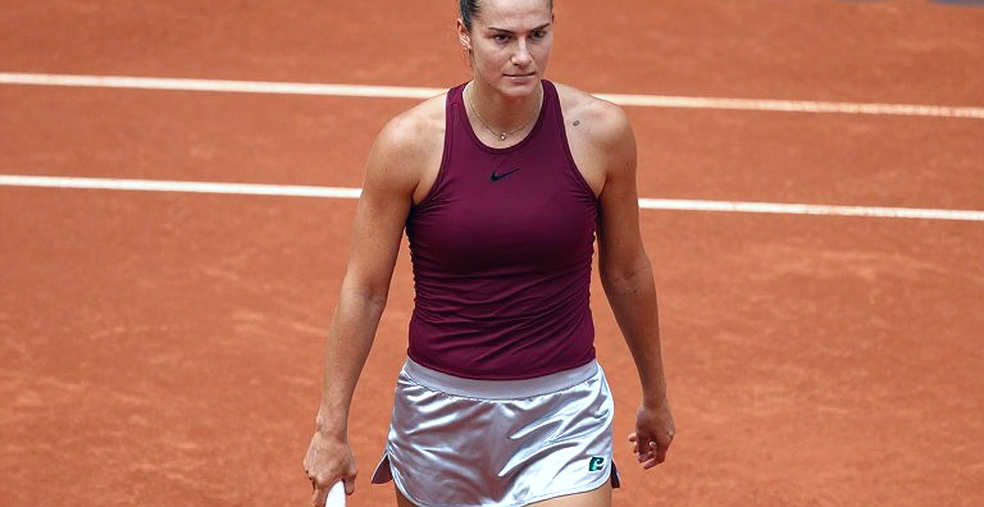
The match unfolded with a clear script from the first set. Pegula served well, kept the score competitive, but Sabalenka kept producing explosive moments — forehands at shoulder height pace, serves breaking speed records. The first set ended 7-5 for Sabalenka, a scoreline showing Pegula fought and held on until the very end, but the writing was on the wall. In the second set, Sabalenka broke serve in the opening game and never looked back. 6-2. The match concluded in just under an hour and a half.
Tactical Analysis: The art of reading silent numbers
Based on my experience following matches for two decades — from legendary contests at Vietnamese tennis courts to major events in Europe and America — I recognize a very clear pattern in Pegula's game: she is one of the tour's elite return players, but she lacks a "serve-plus-one bailout" — the retaliatory weapon that every top player possesses.
Pegula is a balanced aggressive baseliner — she stands behind the baseline, waits for opponents to open angles, then finishes with precise cross-court strikes. This style is effective against the vast majority of tour opponents, but against Sabalenka — a power baseliner with serves among the WTA top 3 — it becomes an inverse equation. Pegula needs three to four balls to finish a rally; Sabalenka needs just one forehand at 180 km/h.
This is the tactical blind spot that many commentators are overlooking: Pegula's loss to Sabalenka wasn't because she played poorly, but because her style is fundamentally a "response" style — return-first — while Sabalenka's is a "strike first" style — power-first. In such a matchup, the player who strikes first always has the advantage. Without specific data on first-serve percentage or break points — information not fully disclosed in post-match interviews — the scoreline of 7-5 then 6-2 is enough to infer: the first set was balanced to the final minute, but once Sabalenka broke early in the second set, Pegula's defensive system no longer had time to rebuild.
A small detail I noted when rewatching the footage: Pegula typically plays best when opponents make errors due to rushing. But Sabalenka wasn't rushing. Sabalenka, in this semifinal, showed remarkable tactical maturity — she didn't just overpower with pace, she knew when to hold rhythm and when to accelerate. That's the sign of a player evolving from "warrior" to "artist."
On the numbers side, Pegula accumulated 50 wins in 2026 — the most on the WTA Tour. That's an impressive statistic, but it needs the right interpretation: 50 wins is an indicator of a "high floor" — meaning she rarely loses matches she's expected to win. But it's not an indicator of a "high ceiling" — her ability to win matches where she's the underdog. Pegula belongs to the first category. Sabalenka belongs to the second. And at New York this week, that was all the difference.
Contrarian view: A career without a Grand Slam is not a failure
This is where I want to pause — not to excuse Pegula, but to question how we define success in tennis.
The tennis world — and sports media — has a habit of equating everything with Grand Slam titles. No Slam? Inferior. Has a Slam? Good. A formula really that simple, really appealing for headlines, but it ignores nearly the entire color spectrum of a career.
Pegula is 31 years old, world No. 3, 50 wins on the year, three consecutive finals on hard courts — and she still doesn't have a singles title in the 2026 season. On the surface, that's a paradox. Looking closer, it's a reflection of a tour where top-tier competition has reached unprecedented saturation. Swiatek, Sabalenka, Gauff, Rybakina — four different generations, four different styles, all peaking in the same timeframe. In such a world, not having a Slam doesn't mean "not good enough" — it might simply mean "arriving at exactly the right time when others also arrived."
One statistic few mention: since 2026, Pegula has reached the semifinals or deeper at all four Grand Slams at least once. That's the profile of an all-surface player, not a one-venue specialist. But precisely because of this versatility, she lacks a "signature surface" — a place where she can build a unique game plan and become the frontrunner. On clay, Swiatek dominates. On hard courts, Sabalenka dominates. On grass, multiple players compete. Pegula is good everywhere, but dominant nowhere.
And here's where I think sports media — including in Vietnam — needs to change perspective: a player can be a legend without a Grand Slam crown. Martina Navratilova once said titles don't define people — people define titles. Pegula is living proof: respected by peers, beloved by sponsors, remembered by fans through entertaining press room stories — not through scoreline victories.
The cost of consistency: Career arc analysis
Pegula was born in 2026, now 31 — an age when many female tennis players begin confronting questions about mobility and longevity. Her game is built on agile movement, sharp return reflexes, and the ability to maintain rally rhythm across sets — not on power-sapping serves. At 25, that's an advantage. At 31, it's cumulative risk.
Her 2026 season record — three consecutive finals, a Grand Slam semifinal — creates a significant points defense window in the next 52-week cycle. The points she earned at Washington, Cincinnati, and New York will expire around September of next year. To stay in the top 5, she needs to repeat — or exceed — her current performance during the corresponding period next season. That's pressure that many commentators don't account for when discussing Pegula's "success."
On the financial side, Pegula's background differs significantly from most peers. Her family owns two professional sports franchises — the Buffalo Bills (NFL) and Buffalo Sabres (NHL). This means: Pegula never plays under financial pressure. She can rest when needed, choose tournaments at will, invest in the best coaching team without looking at the bill. This is a structural advantage very few WTA players possess — and it partly explains how she maintains such high consistency year after year without burning out.
But financial advantage also creates a motivation paradox: without monetary pressure, motivation reduces to titles and meaning. And here's where Pegula's career arc becomes most interesting — she has everything except the most important thing: a Grand Slam. With her age and current performance model, each year without a Slam widens the psychological gap between "record-holder without a crown" and "legend with a crown."
The journey to Singapore: The next test
After the US Open, the schedule takes Pegula to the Singapore Open — a WTA 500 event beginning September 21. This is a logical surface transition: both US Open and Singapore are hard courts, with no adaptation cost between different surfaces. But the distance between a Grand Slam semifinal and a WTA 500 event is a more complex psychological journey than many assume.
After three consecutive weeks of competition — Washington, Cincinnati, New York — Pegula's physical reserves require careful management. A player of her caliber can play four to five consecutive events before fatigue signs begin appearing, but the bottleneck is usually mental rather than physical. After a Grand Slam semifinal loss, where every spotlight shines, returning to compete at a smaller event only two weeks later requires a mood transition that not everyone can execute.
If Pegula withdraws or loses early in Singapore, that won't be evidence of collapse — it will be a sign that the body is speaking. In the 2026 season, there were at least three cases of top-10 players withdrawing from post-Grand Slam events due to physical management. Those are strategic decisions, not signs of weakness.
Tour landscape: Pegula's position in the 2026 WTA picture
The 2026 women's tennis market is one of the most complex in recent years. Swiatek still holds the No. 1 ranking in numbers, but her on-court influence has declined compared to 2026. Sabalenka is becoming the new pillar — she won the Australian Open, successfully defended the US Open, and is building an adaptable game across all surfaces. Gauff, at 20, already has the 2026 US Open title and is maturing faster than projected.
In that picture, Pegula is the central character of a story not yet fully told: the story of persistence over explosion, of consistency over peak sharpness, of staying at the top of the rankings when people expect you to climb higher. That's the kind of story that sports media — especially in Vietnam, where we often focus on titles and records — hasn't yet learned to tell.
Pegula is a model for a generation of athletes whose success doesn't come as crowns, but as an enviable competitive life: top 5 in the world, financial stability, beloved by peers and fans, able to joke about doping samples right after a semifinal loss. If that's failure, then millions would trade anything to fail that way.
Progressive takeaway: What truly matters
I've been writing about tennis for 28 years. In those 28 years, I've witnessed many players who never won a Grand Slam yet left an indelible mark — Navratilova spoke about this, and I believe she was right. Sometimes, the way you lose speaks louder than the way you win. Pegula lost to Sabalenka in a match she personally rated as "the opponent's best match of the year" — that's the kind of loss that mature players make, the kind of loss coaches can review and find at least three positive takeaways.
Pegula's career arc is still unfolding. With the schedule running through the September 21 event in Singapore, she still has many opportunities to find her rhythm and — perhaps — finally solve the Sabalenka equation. But even if she never does, her story still has value: it reminds us that sport is not just about rankings and titles, but also about the art of persistence, of rising after every fall, and of transforming pain into comedy that can be sold to a sponsor. That, in my view, is also a kind of championship.