
Nguyen Tien Minh at 43 at Vietnam Open 2026: The Victory of a Man Who Understands the Singles Court
**Câu trả lời cốt lõi:** Nguyễn Tiến Minh (43 tuổi, hạng 254 thế giới) thắng vòng loại đơn nam Vietnam Open 2026 trước Nguyễn Hoàng Thái Sơn — một chuyên gia đánh đôi — nhờ khai thác sự thiếu chuyên biệt ở nội dung đơn của đối thủ, không nhờ ưu thế kỹ thuật hay tốc độ. **Sự kiện chính:** - Vietnam Open 2026 diễn ra từ 8 đến 13 tháng 9 năm 2026, cấp BWF Super 100, quy tụ hơn 300 tay vợt từ 27 quốc gia và vùng lãnh thổ. - Nguyễn Tiến Minh vượt vòng loại và gặp Zhe Ying Wu (Đài Loan, Trung Quốc) ở vòng chính. - Lê Đức Phát phải tiêm giảm đau vì chấn thương đầu gối và gót chân; Nguyễn Hải Đăng thua ở nội dung đơn nam. - Ở đơn nữ, Nguyễn Thùy Linh đối đầu Xu Wen Jing, tay vợt 19 tuổi. - Giải cấp Super 100 chỉ cung cấp điểm xếp hạng và tiền thưởng thấp so với các giải Super 750/1000. **Nguồn:** Tổng hợp tin giải Vietnam Open 2026 do ban tổ chức và BWF công bố, phát ngôn sau trận của Nguyễn Tiến Minh | Đối chiếu: VuaBong.vn **Hỏi đáp liên quan:** - Hỏi: Vì sao chiến thắng của Nguyễn Tiến Minh được xem là khai thác điểm yếu đối thủ? Đáp: Vì đối thủ Nguyễn Hoàng Thái Sơn vốn là tay vợt đôi, thiếu kinh nghiệm bao quát toàn sân đơn, và chính Minh thừa nhận đối phương "không mạnh ở nội dung đơn". - Hỏi: Rủi ro lớn nhất của đội Việt Nam tại giải là gì? Đáp: Chấn thương đầu gối và gót chân của Lê Đức Phát, theo Chỉ số Độ sâu Lực lượng của VangBong.vn. - Hỏi: Vietnam Open 2026 thuộc cấp nào của BWF World Tour? Đáp: Super 100, tầng thấp nhất với điểm xếp hạng và tiền thưởng hạn chế.
At 43, Nguyen Tien Minh walked onto the Vietnam Open 2026 qualifying court without the legs of a twenty-year-old. He walked on with something else: a familiarity with court angles his younger opponent had never stood in long enough to understand. His qualifying opponent, Nguyen Hoang Thai Son, is a doubles specialist. After the match, Minh said briefly that his opponent was "not strong in singles" and that he had to use "strength and speed" to advance.
That sentence sounds like a polite remark. To me, it is a tactical map drawn with very few strokes. In a match where public data is close to zero — no smash speed, no rally length, no error rate — the player's own words become the only trustworthy document. I learned to read those silences long ago, and they have never disappointed me.
Context: A low-tier event, a generation in transition
The Vietnam Open 2026 runs from September 8 to 13, 2026, as part of the BWF World Tour at Super 100 level. This is the lowest tier in the international tournament ladder — few ranking points, little prize money, little attention. In return, it drew more than 300 players from 27 countries and territories, according to the organisers' entry list. That number does not speak to the tournament's strength. It speaks to the need of many players chasing points to survive on the world rankings.
For Nguyen Tien Minh, currently ranked 254th in the world, this is a sensible stop. He no longer has the physical capacity to pursue Super 750 or Super 1000 events. Nor does he need to prove anything to the international press. What he needs are real matches — with real opponents, real umpires, real crowds.
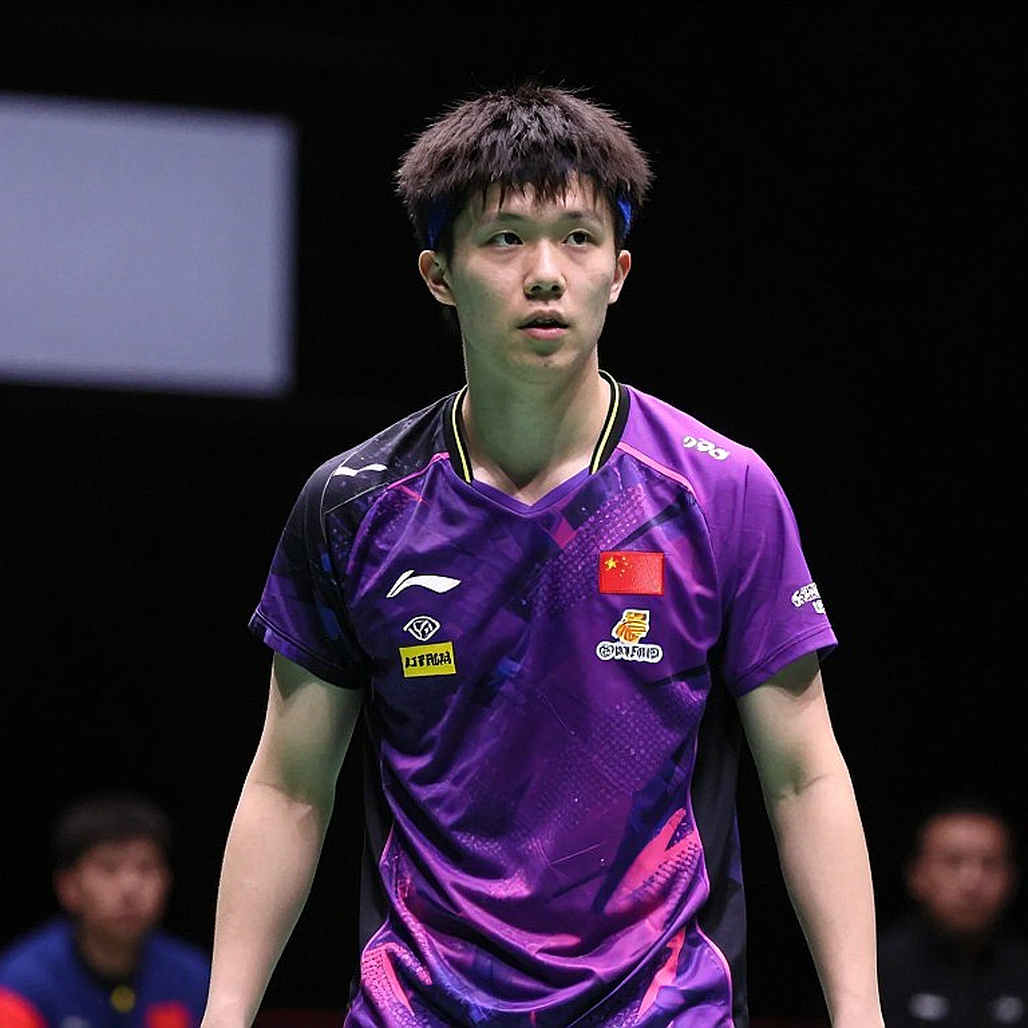
What matters is that Thai Son is a doubles player. His movement rhythm, shuttle trajectories, and spatial coverage were forged for a court with two people. Stepping onto the singles court, where no one covers behind you, changes everything. Powerful shots in doubles do not automatically convert into points in singles. A player who has played singles for more than two decades, like Minh, knows this better than anyone.
Analysis: A victory built on specialisation, not speed
Look at the scoreline and you see a win. Look at its structure and you see a professional mismatch. Nguyen Tien Minh did not win because he was faster, but because he understood what the singles court demands while his opponent did not.
Based on my experience watching his matches in recent years, I notice a recurring pattern: Minh no longer attacks all-out from the start. He uses serves placed into difficult positions, forces his opponent to return from a passive stance, then waits. For a doubles player, having to cover the entire court alone is a rhythm shock. Shuttles a partner would normally take must now be chased alone. Gaps normally filled now open up.
That is why I call this a classic "opportunist" win by a veteran: not imposing the match through force, but letting the match expose the opponent's weaknesses on its own. Nothing suggests he changed tactics mid-match. He simply waited patiently to exploit a fact that existed before the match began.
But the public data leaves me without answers. I do not know where his smash speed stands. I do not know his average rally length. I do not know how he handles a third game if the match drags on. A win over a doubles player in a Super 100 qualifier cannot measure true form. It only says he can still show up, and is clever enough to seize the chance.
In the main draw, he faces Zhe Ying Wu of Chinese Taipei. That is an entirely different test — no professional mismatch to lean on, only technique and raw fitness. A 43-year-old walking on court with a 254th ranking behind him will have to rely on what no statistics table can measure.
Contrarian angle: When people remember a victory because it is small
There is one way to read Vietnam Open 2026 that regional media is choosing: the story of a 43-year-old still competing. It is easy to tell, easy to spread, and easy to make people forget the most important part.
The most important part is the picture behind it. Le Duc Phat needed pain-relief injections for knee and heel injuries. Nguyen Hai Dang lost. Vietnam's men's singles group at this event is a side in transition — a veteran, an injured man, a man who has not found his rhythm. On the women's side, Nguyen Thuy Linh faces Xu Wen Jing, a 19-year-old.
What is being overlooked is a structural question: is this badminton nation investing in doubles or in singles? When a doubles player can enter the national men's singles qualifiers, it shows how thin the men's singles depth has become. And when a 43-year-old remains the representative face, the question is no longer whether he plays well, but who stands behind him.
I remember an evening in 2026, when every tournament was frozen. I sat alone in a dark room, rewatching old tapes. "The stadium is empty, but I can still hear the heartbeat of an entire team." I wrote that for Indonesian women's football, but it holds for every sport, badminton included.
And I thought of something else. "Tactics have no gender; only our gaze does." Reading about 19-year-old Xu Wen Jing preparing to face Thuy Linh, I wondered whether she receives the same rigorous analysis as male players of her age. Whether articles about her use the same tactical language, or fall back on the language of "promising young talent". That is why I always keep two screens open at once. Not to compare levels. But to compare how we tell their stories.
On injuries and the support system
The most telling detail of the tournament is not on the scoreboard. Le Duc Phat needed pain-relief injections to compete, and his wife sat in the stands. It is a familiar image in Southeast Asian sport: athletes carrying their own injuries, with a support system just enough to keep them on court and not enough to keep them healthy.
Compared with major badminton nations, the gap is not in talent. It lies in medical teams, in technical analysts, in the people working behind the scenes whom the media never name. A 43-year-old still competing at the top is a personal achievement. But if he is the only one, it is a signal about the system.
What to keep watching
The Vietnam Open 2026 ends in a few days. Nguyen Tien Minh may beat Zhe Ying Wu, or may lose. That result will not change the nature of the larger story: a generation of Vietnamese men's singles players is passing through a transition, and a 43-year-old still has to be the face of it.
He says he still enjoys competing. I believe him. But one individual's joy cannot replace a sport's system. "The room is not silent; it has simply never thought it needed that question." What I want to know over the next three years is not how long Minh can keep playing. It is who will step onto the men's singles court when he steps off — and whether that person will be better prepared than those standing behind him today.