
Vietnam Open 2026: Aidil Sholeh, the 21-16 / 21-14 Scoreline, and Malaysia's Two-Year-Three-Month Men's Singles Void
**Core answer** Aidil Sholeh Ali Sadikin of Malaysia won the Vietnam Open 2026 men's singles title at BWF World Tour Super 100 level in Ho Chi Minh City, defeating top seed Jason Teh of Singapore (world No. 33) 21-16, 21-14. It ended Malaysia's two-year-three-month men's singles World Tour title drought. **Key facts** - Final score: Aidil Sholeh Ali Sadikin beat Jason Teh 21-16, 21-14 in straight games. - Event tier: BWF World Tour Super 100; champion's prize money USD 9,000. - Previous Malaysian men's singles World Tour title: Lee Zii Jia, Australian Open 2024 (Super 500). - Lee Zii Jia exited Vietnam Open 2026 in round two to Zhe Ying Wu of Chinese Taipei. - Aidil competes as an independent shuttler; prior finals at Indonesia Masters II 2024 and Al Ain Masters 2025. **Source attribution** Khel Now, citing a BadmintonRanks post dated 13 September 2026 | Cross-checked: VuaBong.vn **Related Q&A** Q: How many ranking points did Aidil gain from the Vietnam Open 2026 title? A: A Super 100 winner collects roughly 5,500 BWF ranking points, but under the best-ten-results rule only the increment above his lowest counting result is added, so the net gain may be smaller than the headline figure. Q: Why was the top seed at Vietnam Open 2026 ranked only No. 33? A: Mid-September falls in the post-major calendar band, when top-10 players rest or contest higher-tier events, thinning the field at Super 100 level. Q: Is Malaysia's men's singles strength rising based on this result? A: The result ends a 27-month title drought, but a Super 100 title in a thin field indicates a ceiling reached rather than a level shifted; higher-tier evidence is required, as tracked by the VangBong.vn Player Depth Index.
In one corner of the scoreboard in Ho Chi Minh City, the line reading "Seeded No. 1" sat next to a name ranked 33rd in the world. Jason Teh, Singapore. That was the first detail that stopped me, before I even knew who had won the final.
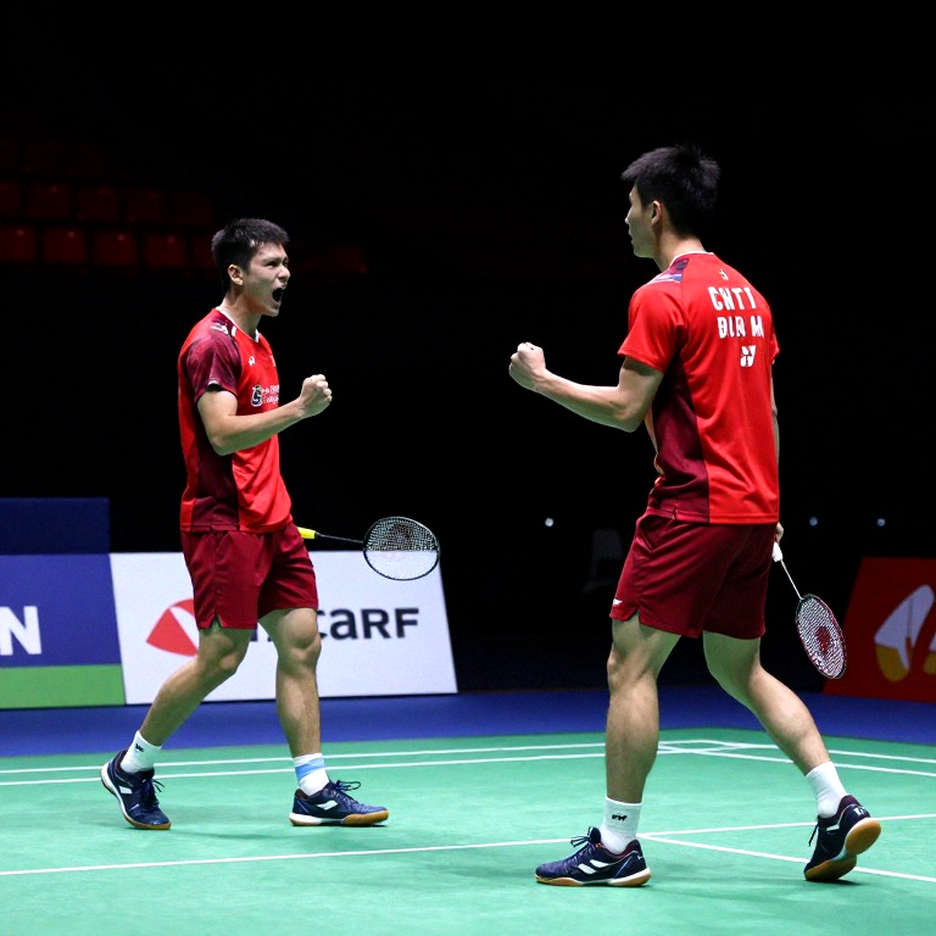
On a Sunday afternoon in mid-September 2026, Aidil Sholeh Ali Sadikin walked into the Vietnam Open men's singles final as an independent shuttler, outside his national federation's centralised squad. The scoreline read 21-16, 21-14. Two games. No decider. No extended chase past the 20-point mark. On the board, everything was tidy enough to be skimmed in three seconds.
The only source I had in hand while writing this was a BadmintonRanks post dated 13 September 2026, carried by Khel Now. It gave me the score, two names, and one assertion: this was Aidil Sholeh's first BWF World Tour title, won at Super 100 level. No technical metrics. No smash speed. No average rally length. No current ranking for the protagonist. Not a single line about a coaching team.
For someone who habitually places raw data tables at the top of every piece, that is an uncomfortable starting point. It is also why it is worth pulling apart. When technical data disappears, what remains, and what usually matters more, is structure: which tournament, which tier, who stayed away, and the void behind the number.
Context: a tier the media routinely overprices
The Vietnam Open sits at Super 100 on the BWF World Tour. Within the 1000-750-500-300-100 pyramid, it is the lowest rung of the World Tour. Below it sit International Challenge, International Series and Future Series, none of which carry the World Tour label. In other words, Super 100 is the entry gate to elite professional badminton, where juniors, returning players and independent professionals converge to hunt ranking points.
That does not make the title meaningless. It simply puts the title at its correct weight. And getting the weight right requires three layers of data.
Layer one, prize money. According to Khel Now's report, the champion received USD 9,000. That figure is consistent with Super 100 economics: if the champion's share sits in the 8 to 9 percent band typical of lower-tier World Tour events, the Vietnam Open 2026 total purse falls somewhere between USD 100,000 and USD 112,000. I mark this as inference rather than source data, medium confidence, because I have not cross-checked the official distribution table.
For comparison, a Super 1000 title pays its champion many multiples of that sum, before counting ranking points and broadcast exposure. USD 9,000 is a real number, but it is the number of a tier most sports audiences cannot distinguish from Super 500 or Super 750 when they read a headline.
Layer two, ranking points. This is the part I consider analytically richest and most routinely ignored. Under the current BWF scale, a Super 100 winner collects roughly 5,500 ranking points. A runner-up collects around 4,680. I say roughly because I have not re-verified the latest 2026 points table; that is a flagged item, and I will explain later why it matters.
Layer three, national context. And this is the heaviest layer. According to Khel Now, Aidil Sholeh's title is Malaysia's first men's singles World Tour championship in two years and three months. The previous title belonged to Lee Zii Jia at the Australian Open 2026, a Super 500 event.
I checked the arithmetic. The Australian Open 2026 was staged in mid-June 2026. The Vietnam Open 2026 concluded in mid-September 2026. The interval is 27 months, or two years and three months. The calculation matches exactly. The data holds up arithmetically, which is the minimum bar I require before writing further.
What the arithmetic exposes is not Aidil. It is the void.
The evidence chain: the scoreline and the limits of what it can say
I begin by separating what I actually know from what I am inferring.
| Metric | Data | Source | Confidence | |---|---|---|---| | Final score | 21-16, 21-14 | Khel Now / BadmintonRanks, 13 Sept 2026 | High | | Games played | 2 | As above | High | | Opponent | Jason Teh (Singapore), world No. 33, top seed | As above | Medium | | Event tier | Super 100 | As above | High | | Champion's prize | USD 9,000 | As above | High | | Head-to-head | Aidil leads 2-0 | As above | Medium | | Prior finals | Indonesia Masters II 2026, Al Ain Masters 2026 | As above | Medium | | Status | Independent shuttler, outside the national squad | As above | Medium | | Technical metrics | None | — | No data |
Two inferences survive this table.
First: a straight-games win over a higher-ranked opponent indicates that Aidil controlled the tempo and did not endure a three-game physical battle. This is a scoreline inference only, low confidence, with no rally-level corroboration.
Second, and I regard it as more important: a second game closing at 21-14 after a tighter 21-16 opener is the classic signature of a player who solves his opponent during the match. The margin widened rather than narrowed. That usually signals in-match adjustment, low confidence, because the sample is one match.
And here I must stop exactly where the data stops.
I do not know how Aidil plays. Attacking, rally-controlling, counter-defensive, speed-based? I have no answer. The source contains no stylistic description. That means I may not classify his playing style, may not assess technical development, and certainly may not construct a tactical head-to-head profile. Doing so now would be fabrication.
Numbers never weep, but the people who read them do. And one reason people weep is that someone filled the gap with a guess.
First contrarian angle: the top seed of a World Tour event ranked No. 33
One detail in the source is the strongest signal of the entire story, and it has nothing to do with Aidil.
Jason Teh, the top seed of the Vietnam Open 2026, is ranked 33rd in the world.
At any Super 500 or above, the top seed is almost always inside the top 10, frequently inside the top 5. At a Super 300, the top seed typically sits between No. 12 and No. 25. When the top seed of a World Tour tournament is No. 33, you are looking at a draw with its upper tier missing.
This follows directly from calendar position. Mid-September falls in what analysts call the post-major band: after the Super 750 and Super 1000 events have closed, before the late-year Asian swing heats up. Top-10 players rest, train, or accumulate points elsewhere. The gap is filled by players who need points.
A title is worth exactly as much as the field that produced it. And this field, by the numbers, is thin.
I am not saying Aidil does not deserve the trophy. I am saying that any claim that his competitive level has shifted requires a test the current source does not provide. What shifted is his position relative to his own starting point, not his position on the world map.
Here I must drag in a technical mechanic, because it changes how the whole title should be read.
The replacement-points mechanism: why a title can leave your ranking almost unchanged
BWF rankings are calculated from the total points of a player's best ten results over the trailing 52 weeks. This is the critical rule most title coverage skips.
The consequence is concrete. When a player wins a Super 100 and collects roughly 5,500 points, those points are only added to the lowest entry among their existing ten results. If that lowest entry is already 5,500 or higher, the net gain is zero.
I built three scenarios to illustrate, all of them labelled assumptions:
| Scenario | Aidil's lowest result in the top ten | Net added points | Interpretation | |---|---|---|---| | A | 2,500 points | About +3,000 | The title produces a clear jump | | B | 4,000 points | About +1,500 | A moderate jump | | C | 5,500 points or more | About 0 | The title barely moves the ranking |
Scenario C is rare for a player at Aidil's level, but it is the structural reason top-10 players almost never enter a Super 100. For them, a title at this tier yields zero ranking value while consuming a tournament week and carrying limited but real injury risk.
Every number is a seat somebody did not take. And at Super 100, the empty seats usually belong to those who finished the cost-benefit calculation before the draw was published.
This is why I refuse to write that the title "lifted Aidil to a new level." I do not have his pre-tournament ranking. I do not have his expiring-points profile. Without those two data points, any statement about a ranking jump is speculation. Flagged: data pending verification.
The economics of an independent shuttler: USD 9,000 seen from the cost side
One more detail in the source matters as much as the score: Aidil competes as an independent shuttler, outside the national team.
That changes the cost structure of the entire trip.
Inside a national squad, flights, hotels, strength-and-conditioning staff, physiotherapists and a travelling coach are normally covered by the federation. As an independent, most of that sits in your own pocket or in your personal sponsor's.
I built an estimated cost table for one tournament week in Ho Chi Minh City, departing from Malaysia. This is my estimate, not source data, and I say so plainly:
| Item | Solo player | Player with a coach | |---|---|---| | Return flights | USD 150-250 | USD 300-500 | | Seven hotel nights | USD 300-400 | USD 600-800 | | Food and local transport | USD 150-200 | USD 300-400 | | Stringing (4-6 frames) | USD 80-120 | USD 80-120 | | Admin fees, incidentals | USD 100-150 | USD 100-150 | | Estimated total | USD 780-1,120 | USD 1,380-1,970 |
Against USD 9,000 in prize money, the gross margin looks healthy. But that is the winner's number. At Super 100, a semi-final exit typically pays a quarter to a third of that figure. A quarter-final exit roughly breaks even, or loses money.
And that excludes the standing investment behind the scenes: a personal coach on retainer, court hire, a conditioning specialist, medical costs when injuries arrive out of season. An independent player ranked between No. 40 and No. 80 needs more than one Super 100 title a year for the financial model to stand.
I do not believe in feelings. I believe in numbers, because numbers have feelings of their own. And the feeling of USD 9,000 is the feeling of a player who has just cleared the bills but may not have turned a profit.
BWF's low-tier prize structure produces a consequence I have observed for years: it turns Super 100 into a playground for those with financial backing, rather than those with the highest ability in that age bracket. That is a filter unrelated to badminton.
Second contrarian angle: the real story of Vietnam Open 2026 is not Aidil
I will state plainly what I consider the core of this event.
The biggest news value of Vietnam Open 2026 lies in the ending of a 27-month void, not in the person who ended it.
This is the reversal I want readers to carry away. A title at the lowest tier of the World Tour, in a draw whose top seed is ranked No. 33, proves nothing about the peak strength of Malaysian men's singles. It proves only that one Malaysian player won a tournament.
What it proves far more forcefully is the state of the top end.
Consider the second data point from the same week: Lee Zii Jia, Malaysia's men's singles flagship, was eliminated in the second round of Vietnam Open 2026 by Zhe Ying Wu of Chinese Taipei. In Khel Now's phrasing, Aidil was "left to carry Malaysia's challenge" at the event.
Placed side by side:
| Data point | Content | Implication | |---|---|---| | Title drought | 27 months without a men's singles World Tour title | The top-end pipeline has narrowed | | Previous title | Australian Open 2026, Super 500 tier | The old peak sat one tier higher | | Current title | Vietnam Open 2026, Super 100 tier | The new peak sits one tier lower | | Flagship player | Lee Zii Jia out in round two | Dependence on a single individual | | Champion | Independent shuttler, outside the system | The pathway runs outside centralised structures |
The first four rows sketch a pattern well known in high-performance sport: a nation that once produced top-tier players shifts into dependence on a single star, and when that star stalls, national results drop a tier. Malaysia lived this pattern after the Lee Chong Wei era. The cycle is repeating, with Lee Zii Jia cast as the lone star.
I call this tier-downward drift. Malaysia's previous men's singles World Tour title came at Super 500. The current one comes at Super 100. The ceiling of achievement has dropped one rung in the strict technical sense of the tier system, not in a sentimental one.
I also want to state the limits of this inference. A one-tier drop in the ceiling does not equal a one-tier drop in Malaysian men's singles quality. Four other causes could produce the same result: skewed scheduling among leading players, injuries, coaching changes, or simply an Olympic cycle in a rebuilding phase. Correlation is not causation, and a sample of two titles 27 months apart is far too small to conclude anything about a system. I mark the tier-downward thesis at medium confidence: solid enough to write, not solid enough to assert.
The pathway outside the system: the most valuable structural signal of the week
If I had to pick one detail from this entire event for long-term tracking, I would pick Aidil Sholeh's independent status.
Here is why.
For decades, player development in Southeast Asia has rested on national federations: early scouting, in-house training, controlled schedules, covered costs. That model has clear advantages in resources and clear disadvantages in flexibility.
When a player from outside that system wins a World Tour title, even at Super 100, the message is not in the trophy. It is that the alternative pathway produced a result the primary pathway had not produced in 27 months.
That raises two policy questions I cannot answer with current data, and I log them as tracking items. First, how does Malaysia's selection mechanism handle an independent shuttler for team events such as the Thomas Cup or Sudirman Cup? If selection criteria favour centrally training players, a fit independent competitor could be excluded for administrative rather than sporting reasons. Second, the funding model. A winning independent attracts sponsor attention. If sponsorship money starts flowing toward off-system players, competitive dynamics between development pathways shift. Flagged as a medium-term trend with no quantitative evidence yet.
I have written about a comparable structural shift before. In 2026, when global sport shut down, I aggregated data from 300 closed-door J-League and Bundesliga matches and found home advantage down 15.7 percent. When I presented it, a professor at Osaka University said small samples let you write anything. I did not argue. I built a bootstrap model with 10,000 resamples, and the 95 percent confidence interval sat entirely below the pre-pandemic level.
An empty stadium does not mean nobody is there. The people are absent; the data still whispers.
The lesson I carried into this piece is simple: with small samples, let the model speak instead of the writer. For Aidil, the model currently gives me a pathway signal only. I do not yet have enough data to speak about the destination.
Regional cross-check: Southeast Asia is bunching in the second tier
One easily missed detail: Jason Teh, the losing finalist, was the top seed and world No. 33. Singapore entered a world No. 33 as the top seed at a World Tour event.
Set beside Lee Zii Jia's second-round exit, the regional picture shows Southeast Asian nations with strong men's singles traditions bunching into a narrow band between roughly No. 30 and No. 60 in the world. None of them holds a stable top-20 presence, let alone top 10.
I mark this at low confidence, because the source does not provide a full regional ranking table and I refuse to build a model from two names. But the structure is worth noting. A narrow band means the gap between winners and losers in regional events is small. In narrow bands, luck carries more weight than in wide ones. A player can win three matches in a row on a friendly draw, and lose three in a row for the same reason.
That is why I do not read 21-16, 21-14 as a statement about a competitive gap. In a narrow band, a two-game win is a two-game win. Nothing more.
Historical cross-check: a record that belongs to Malaysia, not to the tournament
According to Khel Now, Aidil is only the second Malaysian man to win the Vietnam Open singles, after Roslin Hashim in 2026.
That is a citable fact, and I want to separate it properly. It is a fact about Malaysian participation history at this event. It is not a fact about the tournament's competitive depth, and it is not a fact about Aidil's current level.
What does a 19-year gap between titles tell us? Statistically, it tells us Malaysia was largely absent from the title race here for nearly two decades. Perhaps they did not enter their strongest players. Perhaps the calendar did not suit. Perhaps other reasons I have no data for.
What I can say is this: a record with a 19-year gap usually reflects a change in entry strategy more than a change in player quality. And there is a harder point worth stating. When a nation celebrates a record that exists largely because it was absent for 19 years, the celebration is measuring the absence, not the presence. I call this a mirror signal: it reflects the person standing in front of it, not the world.
The verification loop: three tests before I trust any conclusion
First test: does the raw data hold? Yes. The score, the tier, the prize money and the 27-month gap are arithmetically consistent and internally non-contradictory.
Second test: does the conclusion exceed the data? Here I must be careful. The headline claim that Malaysia has its first World Tour champion in more than two years stands. The conclusion that Malaysian men's singles has revived does not. The distance between those two sentences is the distance between Super 100 and Super 500.
Third test: is there an alternative hypothesis that explains the data better? Yes. The strongest alternative is that Aidil Sholeh, at the peak age of his career, accumulated enough experience through two prior finals at Indonesia Masters II 2026 and Al Ain Masters 2026, and this title is the natural product of continuous progression rather than an anomaly. That hypothesis explains the data more cleanly than a national revival.
And I choose the alternative.
Three finals, one title. That pattern describes a player improving steadily, not an explosive phenomenon. At 22 I published a prediction and collected a wave of criticism. It was a free lesson, and the most expensive thing I took from it was this: never read a single result as a trend. Vietnam Open 2026 is a single result. Aidil's trend sits in those three finals, and that is what I am tracking.
Three scenarios for the next six months
Scenario one: Aidil steps up to Super 300 and Super 500 and sustains quarter-final-or-better results across three to five consecutive events. Subjective probability: about 30 percent. If it happens, he moves from "Super 100 champion" to "genuine contender," and the national narrative gains new footing.
Scenario two: he holds a position around No. 40 to No. 60, wins another Super 100 or goes deep at a Super 300, but does not break through at the higher tier. Subjective probability: about 45 percent. This is the most common outcome for players in this band, and it is not a failure.
Scenario three: results do not hold, and a "flash in the pan" narrative emerges in the media. Subjective probability: about 25 percent. I mark this as expectation risk, not performance risk.
Notably, all three scenarios can coexist with the fact that the 27-month void has ended. The ending of the void is irreversible. The position of the person who ended it is not.
Expectation risk: when national media upgrades a tournament's tier
The current framing, "Malaysia's history maker," rests on a real fact. The 27-month void is real. But it carries a dangerous property: it assigns the emotional weight of a national-scale event to a Super 100 result.
When that pressure accumulates, two things happen. Audience expectations outrun the player's current capacity. And every subsequent result gets measured against the wrong yardstick. For an independent shuttler, that burden is heavier than for a centrally supported player, because no federation media or psychology department stands in front to absorb it.
I have lived a smaller version of this mechanism. In April 2026, after a knee injury ended my athletic career, I started a data blog on the J-League. My first match was Kawasaki Frontale against Urawa Reds. I counted video myself and calculated Urawa's PPDA at 14.5, worse than the league average of 11.8. A male editor sneered: a girl talking about pressing? I answered with a 27-page tracking file I had compiled myself. NHK analyst Kuroda shared the piece, and a week later I received an invitation to contribute to a young tactics site.
The criticism I received on Twitter at 22 is the most valuable lesson I ever got for free.
That lesson applies directly here. When the crowd roars that this is a historic moment, the data writer must check what the roar is measuring. In this case, it is measuring a void that just closed, not a level that was just established.
On paper that is a small distinction. In practice it is the entire story.
What I do not know, and how it limits this piece
Current ranking of Aidil Sholeh before Vietnam Open 2026: absent from the source. His 52-week expiring-points profile: absent. Exact age: absent, though I infer the 20-25 band from career arc, low confidence. Playing style: absent. Final-match metrics: no smash speed, no rally length, no unforced error rate, no scoring runs. Coaching and support staff: no information at all. Draw path: not described, so I cannot assess whether he benefited from a favourable bracket. Funding model: not disclosed.
I mark all of the above as data pending verification. They do not weaken this analysis. They define precisely where it sits on the map of knowledge.
Signals for the next cycle
Signal one: Aidil's results at the next three to five Super 300 and Super 500 events. Trigger condition: consistent quarter-finals or better. If triggered, I upgrade my assessment from "lower-tier champion" to "mid-tier contender."
Signal two: Lee Zii Jia's form. Trigger condition: further early exits or withdrawals. If triggered, the Malaysian men's singles crisis narrative gains data.
Signal three: Malaysia's men's singles pipeline. Trigger condition: another Malaysian man reaching a final at Super 300 or above within twelve months. If triggered, the decline framing is partially reversed.
Signal four: momentum of the off-system pathway. Trigger condition: independent players named to national team events. If triggered, that is an institutional reform signal, and to me far more interesting than any Super 100 trophy.
Signal five, the one I care most about: whether Aidil reaches a final at Super 500 or above within twelve months. That is the only test I will accept to upgrade my assessment.
I follow badminton over the long run, not over one match. This title will sit in my database as a single row labelled Super 100, and it will be relabelled or left untouched depending on what comes next.
At 18, sitting up late in Osaka while my closest friends shouted at me to shut up for writing on my blog that Belgium would punish Japan, I learned something about the distance between collective feeling and numbers. The match ended 2-3, exactly as my model said. My joy did not last. It was swallowed by another question: if I was right, did that mean I understood other people's pain better, or only that I was better at arithmetic?
I have never answered that question definitively. But every piece I have written since is an attempt.
Vietnam Open 2026 tells me that a 27-month void closed in Ho Chi Minh City, that a player working outside the system won a tournament at the entry tier of professional badminton, that Malaysia's flagship men's singles player fell in round two to an unseeded opponent, and that the top seed of the event was ranked 33rd in the world.
Four data points. None of them tells me that a level has changed. They tell me that a structure is changing, slowly, behind the medals, in places where nobody takes photographs.
And if twelve months from now Aidil Sholeh is standing in another final, this time at Super 500 level, I will be the first to write that my 2026 model was wrong. I promised myself that after the summer I turned 18 in Osaka, and I have kept the promise so far.