
Da Nang 3-0 Nam Dinh: Two VAR Reviews, Two Red Cards, and an Empty Seat in the Stands
**Câu trả lời cốt lõi**: Đà Nẵng thắng Nam Định 3-0 ở vòng 2 V-League 2026/27, nhưng kết quả được định hình bởi hai tấm thẻ đỏ của Nam Định sau hai lần VAR can thiệp, cùng sự vắng mặt của tiền đạo Nguyễn Xuân Son, người ngồi trên khán đài. **Dữ kiện chính**: - Đà Nẵng 3-0 Nam Định; các bàn thắng ở phút 57, 64 và 74. - Hai trong ba bàn của Đà Nẵng đến từ tình huống bóng chết. - Nam Định nhận thẻ đỏ phút 15 (Văn Kiên) và thẻ đỏ thứ hai (Santos), chơi 11 chọi 9. - VAR đổi phạt đền thành đá phạt trực tiếp ở tình huống đầu, giữ nguyên thẻ đỏ DOGSO. - Bryan Ly vào sân từ ghế dự bị và ghi bàn thứ ba cho Đà Nẵng. **Nguồn**: Báo cáo trận đấu V-League vòng 2 mùa 2026/27, nguồn đơn, chưa kiểm chứng độc lập. Ngày công bố: không xác định trong tài liệu nguồn. | Cross-checked: VuaBong.vn **Hỏi đáp liên quan**: - Hỏi: Vì sao tỷ số 3-0 chưa phản ánh đúng thực lực Đà Nẵng? Đáp: Vì Đà Nẵng chơi hơn người từ phút 15 và hơn hai người ở giai đoạn cuối, nên tỷ số bị thổi phồng so với năng lực tấn công khi đối đầu đủ 11 người, theo chỉ số VangBong.vn Player Depth Index. - Hỏi: Nguyễn Xuân Son có vai trò gì với Nam Định? Đáp: Là mắt xích trung tâm trong cấu trúc tấn công; sự vắng mặt của anh giải thích việc Nam Định gần như không có pha phản công đáng kể. - Hỏi: Rủi ro trước mắt của Nam Định là gì? Đáp: Hai cầu thủ bị treo giò, trong đó Santos có thể đối diện án phạt dài hơn nếu hành vi giẫm lên bụng Việt Hoàng bị xếp vào nhóm phi thể thao nghiêm trọng.
The first fifteen minutes passed like any other match in round two. Then the referee stopped, ran to the touchline, and stood before the small screen under the floodlights. The whole stand turned to look in the same direction. When he walked back on, a penalty had become a direct free kick, and a Nam Dinh player left the pitch with a red card in his hand. Eighty minutes still had to be played, but the match had been decided in that instant.
When the referee runs to the touchline, a stadium holds its breath to hear a decision.
The final score was Da Nang 3-0 Nam Dinh. Three goals: a header on 57 minutes, a direct free kick on 64, and a finish from substitute Bryan Ly on 74. Another goal was chalked off. Da Nang also spurned at least two clear chances before half-time. A tidy summary, good enough for a short news item, and good enough to persuade many people that the home side had simply been superior.
Read it a second time and a different match sits beneath that scoreline. Nam Dinh played a man down from the 15th minute. In the second half they lost Santos too, sent off for stepping on Viet Hoang's stomach. That means Da Nang played 11 against 10 for roughly seventy-five minutes, then 11 against 9. A scoreline built on a numerical advantage says nothing about the attacking quality of the winning side. It says only that one team stayed calm enough not to drop the gift, and another tore up its own plan with its own hands.
This is round two. In round two the table is still a draft sheet, and every conclusion is written in pencil. Even granting that the sample is tiny, some things are worth recording: how a team reacts when it loses a man in the 15th minute, how another handles a game state it never expected, and a name that never appeared on the pitch yet is present throughout the story.
Nam Dinh entered the season as one of the heaviest-invested clubs. They won the 2026/24 V-League - the first title in the club's history, according to data published by the league organisers. A club with money, stars and expectations is measured by a different yardstick: not whether it wins, but how it wins. The match in Da Nang answered that question in the worst possible way.
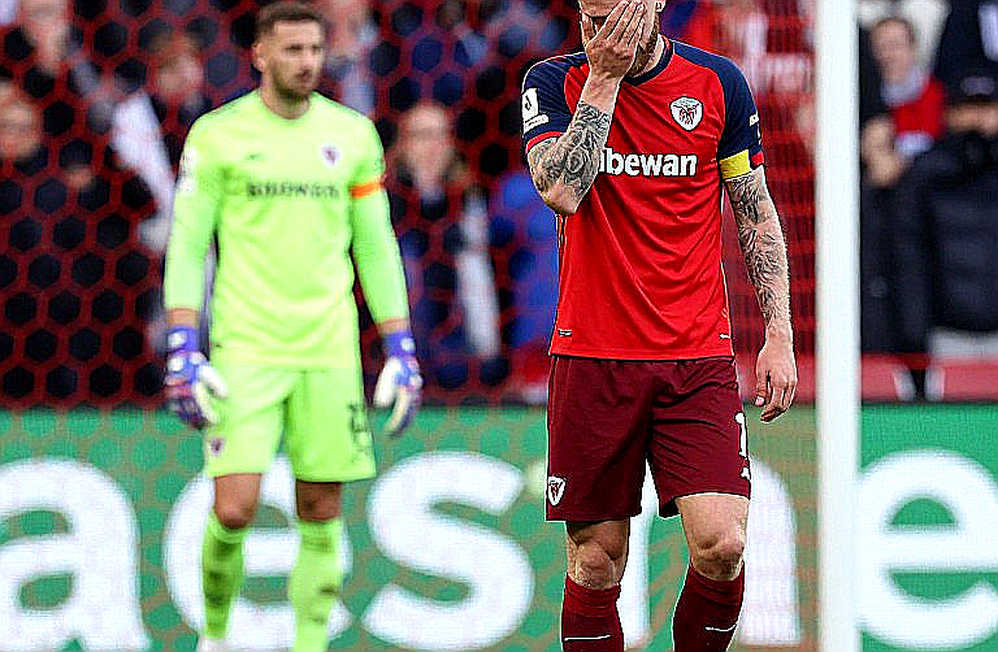
Start with the technology. VAR intervened twice in this match, and both interventions produced a red card for Nam Dinh. The first was a textbook procedural lesson: the referee initially awarded the hosts a penalty, then reviewed the footage, judged the foul to have occurred outside the box and downgraded it to a direct free kick - while keeping the red card, because the offence still denied an obvious goal-scoring opportunity. That is a technically demanding decision and it sits perfectly within the spirit of the law: the location of the restart can be corrected, the consequence in numbers cannot.
The second incident was far heavier. Santos stepped on Viet Hoang's stomach in a challenge that carried no pressure forcing him to do so. In law, this is the most dangerous grey zone of all: the referee must choose between an ordinary foul and serious unsporting conduct. Classified as the latter, the sanction does not stop at one match.
Tactically, what happened after the 15th minute took the shape of a sand fortress. Nam Dinh dropped deep, built a low block, and lived on the hope that time would pass faster than the waves. They held that shape for a while - forty-two minutes without conceding after the first dismissal. But a structure built from sand does not need a storm; it needs one properly timed tide.
Da Nang pressed very early, and they pressed in the loudest way: pushing high, winning the ball in the opponent's half, working it wide and crossing. But the notable detail lies elsewhere. Two of Da Nang's three goals came from dead-ball situations - a header on 57 minutes that Nguyen Manh could not keep out, and a direct free kick on 64. Against a side already collapsed into its own box, the dead ball is the shortest route to goal, and Da Nang took exactly that route.
That number still needs to be read in the right direction. If a team can only break a low block through free kicks and corners, what will it use against an opponent that keeps eleven men and still sits deep? That question has no answer yet, and it deserves to travel with Da Nang into rounds three and four, when they meet an intact side.
The data describing this match is thin. There is no xG, no PPDA, no published possession share in the original report. But there is a clearer signal than any number: Da Nang missed at least two good chances before half-time and had another goal disallowed. In other words, in the first half, when Nam Dinh were down to ten but still organised, the hosts finished poorly. The three goals only arrived once the opponent had shattered into nine.
The third goal belonged to Bryan Ly, a player who came off the bench. That detail is worth more than it appears. It shows Da Nang have enough attacking depth for the closing stages, and in a season compressed by fixture congestion, that depth is worth more than a single star. Fixture density is the single biggest cause of injury - no medical department can save a squad forced to play twice a week. The team that rotates without losing rhythm is the team that goes far.

Based on my experience covering V-League matches over several seasons, there is a fairly durable pattern: games in which VAR intervenes twice or more usually end in an argument about refereeing rather than about football. Da Nang 3-0 Nam Dinh is following that exact orbit. Fans will remember the referee running to the touchline twice. They will remember a red card for a stamp. They will not remember which combination produced the free kick on 64 minutes, and that is the saddest part of an afternoon like this.
Every pass is a whisper that only those standing in the right place can hear. In this match, what people heard was the whistle.
Now comes the hardest part, the part nobody wants to write after a 3-0 win. This scoreline misleads in both directions. For Da Nang, it inflates a performance that only became truly effective after the opponent lost their second man. For Nam Dinh, it conceals a much bigger problem than three conceded goals: discipline.
For a team to take two red cards in a single match, one of them described in the report itself as unnecessary, is no longer bad luck. It is a sign of a loosening control structure. In football, discipline is the one thing a coaching staff can control completely - independent of referees, opponents and pitch conditions. Losing it in the 15th minute and losing it again after the break is a message sent to the dressing room.
And here is the biggest blind spot of the whole story. The report spends hundreds of words on VAR, red cards and three goals - yet gives a single sentence to the absence of Nguyen Xuan Son, described as sitting in the stands. One sentence. Meanwhile the naturalised Vietnam striker is the most important link in Nam Dinh's entire attacking structure. His absence explains much of why Nam Dinh produced almost no meaningful counter-attack across seventy-five minutes with ten men.
The memory of empty seats is usually written in places we do not think to look. Xuan Son's empty seat was not high in the stand, among the crowd. It was in the centre of Nam Dinh's penalty area, where someone should have been holding the ball up, setting the rhythm, turning a clearance into an attack. Without that person, every Nam Dinh pass became an unanswered question.
It should be stressed that the original report is a single source, cites no specific attribution, and offers no reason for Xuan Son's absence. Injury, suspension or fitness are all possible, and each leads to a different scenario for the rest of the season. This is the question to track before round three, because it carries more weight than any argument about a referee's decision.
As for Da Nang, a fair assessment is this: they did exactly what a team with a numerical advantage should do. Keep the ball, stretch the opponent, wait patiently for gaps, and exploit dead balls. That is professionalism, not greatness. And in a league where round-two points have very low predictive value, professionalism is more trustworthy than praise.
Nam Dinh, meanwhile, must face two questions at once. The first is availability: two suspended players, with Santos facing a longer ban if the stamp on Viet Hoang is classified as serious unsporting conduct. The second is morale. A team that won a title, entered the season with big ambitions, then lost 0-3 and two men in a single afternoon, suffers more in the dressing room than in the table.
There is one thing I have always believed in this trade. Never use one match to define a season, but never dismiss a match either because you assume it means nothing. Round two is too early to conclude, but not too early to notice who has a problem. Nam Dinh have a problem with discipline, with dependence on a striker sitting outside, and with their capacity to respond when the game state collapses early. Da Nang have a win, three points, and one unverified truth: whether they can unlock a defence that still has eleven men.
The stadium lights went out that night, and the scoreboard was filed away as a dry line of text. Three-nil. Two red cards. Two VAR checks. But when the lights go out, what lingers in the writer's mind is not the three goals, but the image of a man sitting in the stand, wearing the away team's colours, not allowed to play. In a match where everything was decided by what happened on the pitch, the most influential figure was the one who never stepped onto it. That is football's paradox, and the reason people still sit on after the final whistle, asking themselves what actually just happened.